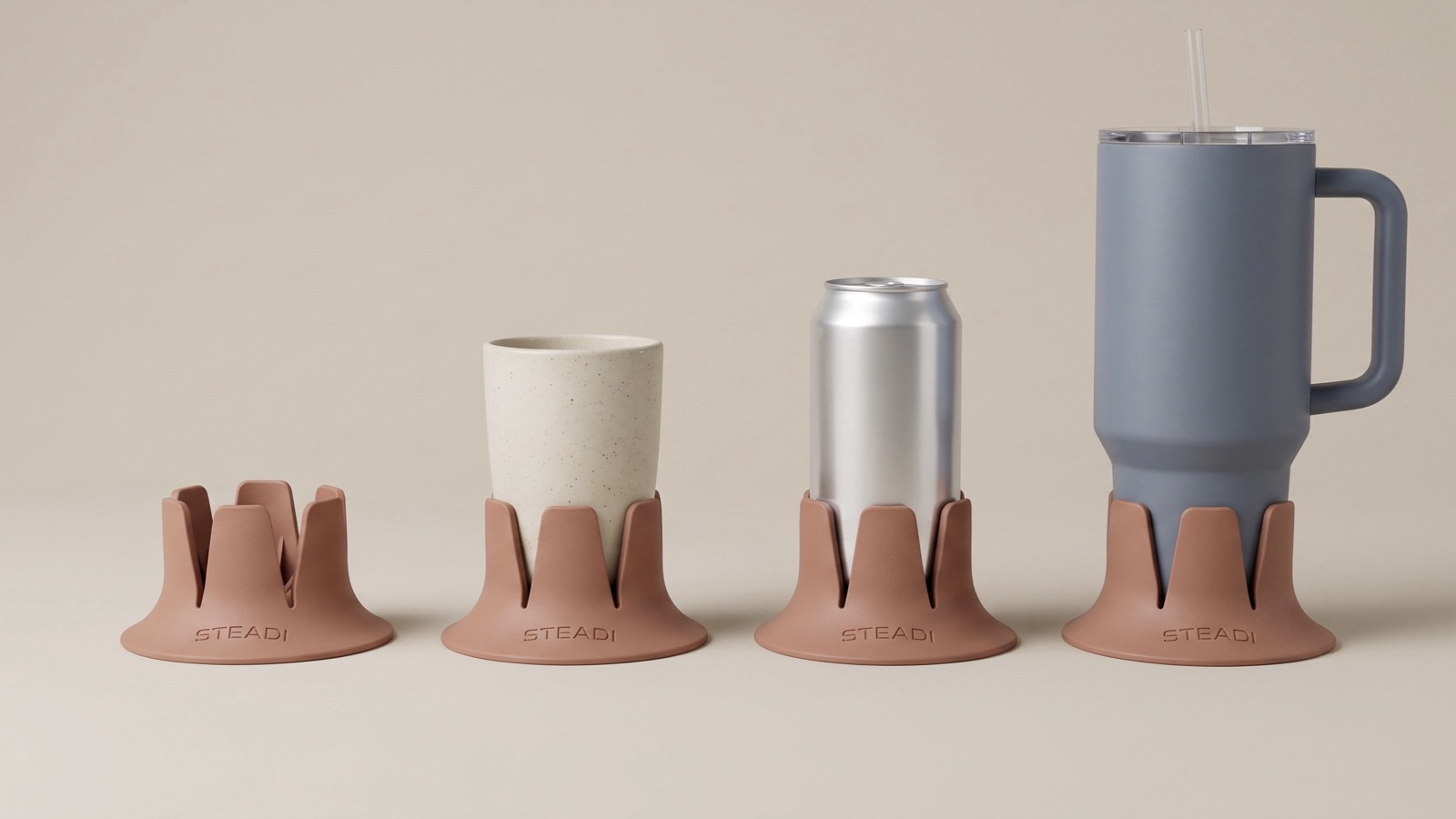
A flexible base that sits on the dash, the bench seat, or the flip seat and holds your can, your tumbler, or the open cup from the beverage cart steady through the cart-path joints. It doesn't clamp to the frame or wedge into the factory well — it sits on top, wherever the cart actually has room.
One flexible base. Empty, then a can, a clubhouse cup, and a 40 oz tumbler — the same base, whichever seat it rides on.
The situation
Every cart ships with two cup holders. Golf needs four.
Where the drinks go on a round isn't one decision — it's a running negotiation among two dash wells, a slick bench seat, and however many players climbed on for the back nine.
The two dash wells.
Molded into the dash around a slim can, decades before anyone carried a 40 oz tumbler — accessory guides say plainly that anything wider than about three inches won't seat. The big ones end up perched on top instead of in it, rattling against bare plastic over every joint.
The bench seat, for the third drink.
Two wells up front, but carts routinely carry three across the bench. The extra cup goes on smooth vinyl that grips nothing — it goes over at the first turn, or the moment someone slides across to climb out.
The rear flip seat.
Factory rear-seat kits ship with zero cup holders of their own, which is why an aftermarket of hundreds of clamp-on rear-seat holders exists. Whoever rides backward there holds a drink in their lap over every bump the driver feels first.
The floorboard.
Set at your feet, a drink slides forward under braking with no door to stop it — and gets kicked over by the next rider swinging a leg in through the open side.
The open cup from the cart girl.
The beverage cart hands over a lidless plastic cup, and the cart has nowhere ready for it — the dash is sloped, the bench is slick, the floor slides. It rides in whoever's free hand until the next tee.
None of it is a disaster. It's a running shortage — two holders, and most rounds carry more drinks than that — and you've stopped noticing you're solving it hole after hole.
You know the moment
You've played this round before.
Saturday, 7:40 am, off the first tee
The travel mug — no handle, just a lid — doesn't seat in the can-sized well, so it rides on top. The first cart-path expansion joint sends coffee out the sip hole and sends it sliding toward the passenger's shins.
Mid back nine, right after the beverage cart pulls away
Two beers and a transfusion bought at the window, and two wells on the dash — one already holding a phone and the scorecard pencil. The extra cup rides between the driver's knees until the next tee.
Cart-path-only morning, after overnight rain
The whole round runs on hard pavement, joint after joint, and the can sitting bare in the dash well rattles for nine holes straight and foams over the second someone finally cracks it open.
6 pm, cruising an LSV to dinner in a cart community like The Villages
The grandkids ride the flip seat facing backward — the seat that shipped with no holder of its own — everyone holding drinks up over every speed bump and tunnel dip between here and the restaurant.
Scramble tournament, mid-morning
The cooler strapped in next to the bag well is the bar for the whole foursome, but nothing on the cart holds an open cup — every pour gets hand-carried until the hard brake at the tee box.
What you get
Three reasons it stays out.
01
Fits what the dash won't
The wide flexible base takes the 40 oz tumbler, the slim seltzer can, and the lidless cup straight from the beverage cart alike — nothing to measure against a well that was molded for a can decades ago.
02
Covers every seat, not just two
Dash, bench, floorboard, the flip seat that came with no holder at all — it goes wherever the extra drink actually ends up, not just the two spots the factory budgeted for.
03
Rides along without a clamp
Nothing mounts to the frame, the rail, or a dash cutout — it sits on top and picks up in a second, so it moves cart to cart, seat to seat, and comes home in the bag at the end of the round.
The fit test
The fit test rides in the same pocket as your scorecard.
your cup's base lands in here
A square sticky note: 3 inches, exactly.
01
Grab a sticky note.
The standard square measures exactly 3 inches on a side — a fact about sticky notes, and it happens to be the outer edge of what the base can hold.
02
Stand your cup on it.
Set the 40 oz Stanley, the transfusion cup, or the can down flat on the note and look at the base, not the rim — the same measurement the dash well already failed.
03
Read the note.
Base sits inside the square? It fits. Hangs off the edge? It's the one the stock well already rejected. A tiny footprint lost in the middle — under about 2 inches? Too narrow to hold steady.
No tape measure at the turn, no guessing before the cart girl comes back around — one sticky note, the cup you're actually holding.
Will it fit my cup
Measure the bottom, not the top.
The rule holds the same on the cart as anywhere else: a container base about 2 to 3 inches across settles in. Every verdict below follows from it.
40 oz Stanley Quencher-style tumbler fits
12 oz can in a foam koozie snug fit
Slim seltzer can fits
Transfusion in a lidless clubhouse cup fits
Travel mug, no handle fits
30 oz Yeti Rambler fits
28 oz Gatorade squeeze bottle fits
16.9 oz disposable water bottle fits
Coffee mug, handled handle in the way
There's a floor as well as a ceiling — under about 2 inches the base sits too loose to grip. The handled coffee mug is the one honest exception: the base fits, but the handle lands right where a fin needs to close.
How it works
Three parts, no moving parts.
The base grips down.
A wide flexible footprint sits flat on the dash, the seat, or the floorboard — no molded well required — and holds its position through the vibration and turf bumps that shake anything narrower loose.
The fins close around it.
Flexible fins hold the bottom inch of whatever's inside — can, tumbler, or a lidless cup straight from the beverage cart — so nothing rattles free over a cart-path joint.
It settles back level.
A hard brake at the tee box, a rut in the rough, a rider climbing in over the open side — the base flexes with the jolt and brings the drink back level instead of letting it go over.
Nothing clamps to the cart. No rail clamp, no dash-cutout insert, no magnet hunting for steel that usually isn't there. It sits on top of whatever's flat — dash, bench, floorboard, flip seat — and moves with you from the cart to the clubhouse.
Know the cart
A cart has five spots for a drink. Only two were ever designed for one.
The reason drinks don't survive eighteen holes isn't clumsiness — it's that the cart only budgeted for two of them, and every cart-path joint does the rest.
The dash wells
Molded around a slim can decades before anyone carried a 40 oz tumbler — guides warn that anything wider than about three inches won't seat, so big tumblers perch on top and rattle against bare plastic over every joint.
The vinyl bench seat
Smooth marine-grade vinyl, slightly crowned — nothing for a cup to grip. It goes over at the first turn, or the moment someone slides across to get out.
The rear flip seat
Fold-out kits ride the same bumps as the front seat but ship with zero holders of their own — riders hold their drinks up in the air, backward, over every dip.
The floorboard
Ribbed, open-sided, and dusted with sand and clippings — a drink set here slides under braking and gets kicked by the next person swinging a leg in.
The cooler lid
Strapped in next to the bag well, it's the de facto bar table on a scramble day — and it jitters with every bit of road and engine vibration the cart carries, with no lip to hold anything set on it.
Versus what you do now
Weighed against what's already clamped to the cart.
The cup holder expander
Needs an existing well to grip, and the stock wells are too shallow to anchor one — owners report it sitting loose and popping out mid-round, and a full 40 oz tumbler on top makes the whole stack top-heavy.
The clamp-on rail holder
Fit depends on matching the roof strut's exact diameter, which differs across Club Car, E-Z-GO, and Yamaha — reviewers report the plastic clamp loosening, swiveling, and eventually cracking, especially on rear-seat armrest units.
The suction-cup holder
Fit guides call suction the least reliable mount on textured cart plastic — sun-baked heat and cart-path vibration work it loose over the course of a round.
The magnetic holder
It only grabs steel, and most of a cart's frame and body panels are aluminum or plastic — there's often nothing under the mount for the magnet to hold.
Before you buy
Questions people actually ask.
Does it actually work on a moving cart?
That's the whole design brief. Cart-path joints, turf bumps, a hard brake at the tee box — the wide flexible base spreads across whatever it's sitting on, and the fins hold the drink from underneath so a jolt doesn't send it over. It resists tipping and settles back level.
Will my 40 oz tumbler actually fit? The dash well won't take it.
The stock well is sized for a slim can, not a tumbler — that's the exact gap this closes. A base about 2 to 3 inches across settles in, and the 40 oz Stanley fits. Handled mugs don't; the handle gets in the way of the fins.
Does it clamp to the dash or the frame?
No. Nothing clamps to a rail, wedges into the dash cutout, or hunts for a magnet-friendly patch of steel. It sits on top of whatever's flat and picks up in a second when the round's over.
Where does it actually go on the cart?
Wherever the drink is. On the dash next to the factory well, on the bench seat for the third player, on the floorboard, or on the rear flip seat that never got a holder of its own.
What about the open cup from the beverage cart?
That's the one thing nothing on the cart is built for. The lidless clubhouse cup drops right in and the fins hold it from the sides — no lid required.
Does it hold up over cart-path-only rounds, joint after joint?
Yes — repeated joints and turf bumps are exactly the movement it's built to shrug off. It's not magic, so a direct hard kick is still a direct hard kick, but the steady jolt of a normal round is the job.
My rear flip seat has zero cup holders. Does this help back there?
Yes. It doesn't need a factory holder to sit in — it sits directly on the flip seat's deck or armrest, so backward-facing riders finally get a spot for their drink too.
How do I clean it?
Rinse it or run it through the dishwasher — one piece of flexible material with nothing to come apart, and no koozie to dry out.
Who makes it, and where do I buy one?
It's called the Steadi, molded in small runs in Orange, California by Steadi Labs — veteran-founded and patent pending. Every order ships free from steadilabs.com, with 30 days to send it back if it doesn't earn a spot on the cart.
Who makes it
Made start to finish in Orange, California.
The maker is Steadi Labs, a small veteran-founded company in Orange, California. It's injection molded — the mold, the material, and the color runs all sit within about three and a half miles of the shop, and every batch is molded there in small runs. The people who make it are the same people who answer hello@steadilabs.com.
Thirty days, wherever you use it.
Use it for a month. If it doesn't do what this page says, email hello@steadilabs.com and it gets made right — no forms, no fight.
Veteran-founded · Patent pending · Made in Orange, California
Give the whole cart a cup holder, not just the dash.
Every seat on the cart gets somewhere for a drink — dash, bench, or the flip seat that never had one — and the transfusion makes it to the next tee without losing a drop to the cart path.